LiteTopic
LiteTopics are lightweight, ephemeral sub-channels within a single Apache RocketMQ topic. You can create millions of fine-grained message channels -- one per session, task, or user -- without the resource overhead of separate topics. Each LiteTopic is an auto-managed secondary container inside a single parent topic, with its own ordered queue, lifecycle, and subscription scope.
Key concepts
What is a LiteTopic
A LiteTopic is a secondary container for message transmission and storage within a parent topic. It groups messages of different child classes -- such as individual sessions, tasks, or users -- under the same business logic.
LiteTopics serve two purposes:
Exclusive consumption and data fencing: Isolate data from different child classes into separate LiteTopics for finer-grained storage and subscription boundaries.
Identity and permissions: Control access at a granularity finer than the topic level by assigning identities and permissions to individual LiteTopics.
How LiteTopics fit into the domain model
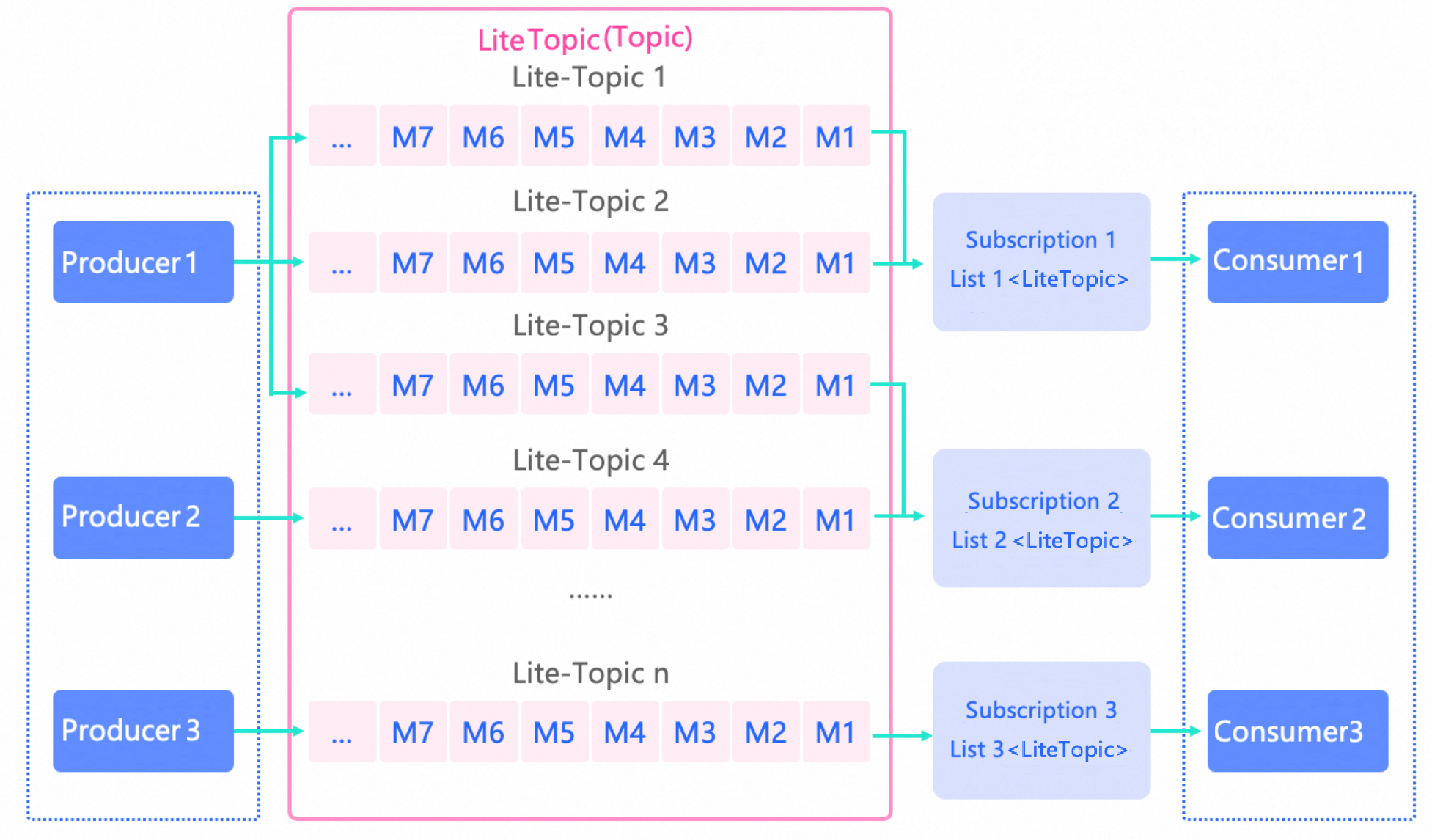
A topic is the top-level container for message transmission and storage in Apache RocketMQ. If a topic is of the Lite type, LiteTopics can be created within it. The combination of a topic and a LiteTopic uniquely identifies a message storage container.
Each LiteTopic contains one queue by default, and messages within that queue are stored and consumed in order.
LiteTopic properties
Name
Must be globally unique within the parent topic.
Auto-created on first use: if
setLiteTopicis called on a message and the specified LiteTopic does not exist, the system creates it automatically.For naming constraints, see Parameter limits.
Time-to-live (TTL)
If a LiteTopic receives no messages for longer than its TTL, the system deletes it automatically. Deletion releases the quota count.
Set the TTL through the
expirationvalue when you create the Lite-type topic.For TTL constraints, see Parameter limits.
Version compatibility
| Component | Minimum version |
|---|---|
| Server | 5.5.0 or later |
| Client (gRPC SDK) | RocketMQ gRPC 5.1.0 or later |
LiteTopics vs. normal topics
Switching a topic to Lite type changes its behavior. Each LiteTopic has only one queue by default, which limits per-channel TPS but enables ordered consumption and fine-grained subscription control. Evaluate this tradeoff before adopting Lite-type topics.
| Dimension | Lite topic | Normal topic |
|---|---|---|
| Primary topic | Both require you to create topic resources in advance. | Same as Lite. |
| Secondary channels | Supports millions of LiteTopics under a single parent topic, each with auto-managed lifecycle. | No secondary channel support. |
| Lifecycle management | Automatic creation on first send or subscribe. Automatic deletion after the configured TTL expires. | Manual creation and deletion only. |
| Ordering | Each LiteTopic has one queue by default. Messages are stored in order. | Multiple queues. Only partitioned ordered topics guarantee order. |
| Per-channel TPS | Limited per LiteTopic (single queue). Total TPS scales with the number of LiteTopics. | TPS scales horizontally by queue count and cluster nodes. |
| Subscription consistency | Flexible: each consumer in the same group can subscribe to a different set of LiteTopics. | Strict: all consumers in the same group must share the same subscription. |
| Consumption mode | Ordered only. Each LiteTopic is processed by one consumer thread. | Ordered or concurrent. |
| Dynamic subscription | Consumers can add or remove LiteTopic subscriptions at runtime. | Not supported. |
| Per-consumer subscription scale | Up to thousands of LiteTopics per consumer. | Not applicable. |
| Observability | Message accumulation metrics available. Message processing latency metrics not available. | Both accumulation and latency metrics available. |
| Message trace | Supported. | Supported. |